Txori
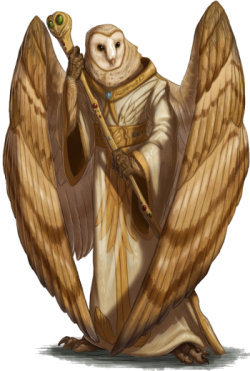
Sequestered in high mountains atop tall trees, the txori — sometimes called birdfolk, bird people, or aarakocra — evoke fear and wonder.
Txori Traits
- Size: 1
- Speed: 5 (Fly)
- Bonus Languages: Txori
- Senses: keen_vision
- Natural Weapons: You can use your beak or talons as a single Nimble natural weapon that deals 1d6 damage.
Txori Novice Path
Level 1 Txori
Suggested Attributes: Strength 10, Agility 13, Intellect 10, Will 10
Natural Defense: 12
Health: 12
Languages: Common, Txori (from ancestral trait)
- Deadly Instincts: While you are not injured, you make Agility rolls with 1 boon; when you make a free attack, you roll with 1 boon.
- Wing Block: When a creature you can see attacks you, you can use a reaction to block the attack with your wing. You impose banes on the roll that enabled the use of this talent. If the attack results in a critical success, however, you lose access to the Fly trait until you heal your entire damage total.
Level 2 Txori
Health: +2
- Diving Attack: You can use this talent when you make a melee attack after flying at least 5 yards. You roll with 1 boon, and the attack deals an extra 1d6 damage.
- Swift Recovery: You can use an action, or a reaction when you are harmed, to heal half your damage total and move up to your Speed. You have the Slippery trait for this movement. Once you use this talent, you lose access to it until after you rest.
Level 5 Txori
Health: +2
Speed: +1 (Fly)
Bonus Damage: +1d6
- Flyby When you use your Diving Attack talent and continue moving after your attack, you do not trigger a free attack from the enemy you attacked.
Lore
Beak and Feather
From below, txori look much like large birds. Only when they descend to roost on a branch or walk across the ground does their humanoid appearance reveal itself. Standing upright, aarakocra might reach 5 feet tall, and they have long, narrow legs that taper to sharp talons.
Feathers cover their bodies. Their plumage typically denotes membership in a tribe. Males are brightly colored, with feathers of red, orange, or yellow. Females often have more subdued colors, usually brown or gray. Their heads complete the avian appearance, being something like a parrot or eagle with distinct tribal variations. The colors and types of plumage they have vary by where they originate from on Aldrea.
Sky Wardens
Nowhere are the Txori more comfortable than in the sky. They can spend hours in the air, and some go as long as days, locking their wings in place and letting the thermals hold them aloft. In battle, they prove dynamic and acrobatic fliers, moving with remarkable speed and grace, diving to lash opponents with weapons or talons before turning and flying away.
Once airborne, a Txori leaves the sky with reluctance. They sometimes forget or ignore vertical distances, and they have nothing but pity for those earthbound people forced to live and toil on the ground. The Txori are linked to the Elemental Plane of Air, calling upon its power to help keep them flying in the air for days.
Avian Mannerisms
The resemblance of txori to birds isn’t limited to physical features. Txori display many of the same mannerisms as ordinary birds. They are fastidious about their plumage, frequently tending their feathers, cleaning and scratching away any tiny passengers they might have picked up. When they deign to descend from the sky, they often do so near pools where they can catch fish and bathe themselves.
Many txori punctuate their speech with chirps, sounds they use to convey emphasis and to shade meaning, much as a human might through facial expressions and gestures. A txori might become frustrated with people who fail to pick up on the nuances; an txori’s threat might be taken as a jest and vice versa.
The idea of ownership of anything not handmade baffles most txori. After all, who can lay claim to the sky? Even when explained to them, they initially find the notion of ownership mystifying. As a result, txori who have little interaction with other people might be a nuisance as they drop from the sky to snatch livestock or plunder harvests for fruits and grains. Shiny, glittering objects catch their eyes. They find it hard not to pluck the treasure and bring it back to their settlement to beautify it. An txori who spends years among other races can learn to inhibit these impulses.
Confinement terrifies the txori. To be grounded, trapped underground, or imprisoned by the cold, unyielding earth is a torment few txori can withstand. Even when perched on a high branch or at rest in their mountaintop homes, they appear alert, with eyes moving and bodies ready to take flight.
Homelands
Txori establish nests in high mountains or in the canopies of old forests. Once tribes of txori settle in an area, they share a hunting territory that extends across an area up to 100 miles on a side, with each tribe hunting in the lands nearest to their colony, ranging farther should game become scarce. A typical colony consists of one large, open-roofed nest made of woven vines. The eldest acts as leader with the support of a shaman.
Great Purpose
Txori enjoy peace and solitude. Most of them have little interest in dealing with other peoples and less interest in spending time on the ground. For this reason, it takes an exceptional circumstance for an txori to leave his or her tribe and undertake the adventurer’s life. Rarely is treasure or glory is enough to lure them from their tribes; a dire threat to their people, a mission of vengeance, or a catastrophe typically lies at the heart of the txori adventurer’s chosen path.
Txori Names
As with much of their speech, txori names include clicks, trills, and whistles to the point that other peoples have a difficult time pronouncing them. Typically, a name has two to four syllables with the sounds acting as connectors. When interacting with other races, txori may use nicknames gained from people they meet or shortened forms of their full names.
A txori of either gender may have one of these short names: Aera, Aial, Aur, Cleek, Deekek, Errk, Heehk, Ikki, Kleeck, Oorr, Ouss, Quaf, Quierk, Salleek, Urreek, or Zeed.