Hobbit
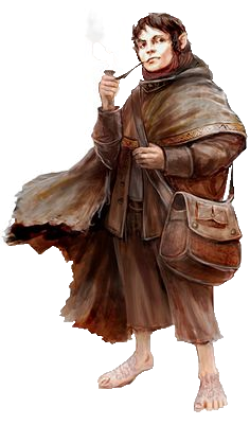
Hobbits are a friendly folk who mostly keep to themselves farming, socializing and living a simple, but happy life.
Hobbit Traits
- Size: 1/2
- Speed: 5
- Immune: poison
- Senses: keen_smell
- Pluck: You can use this trait when you make an attribute roll and get a result you dislike. Discard the result and make a new attribute roll. You must use the second result, even if it is worse than the first. Once you use this trait, you lose access to it for 1 minute.
Hobbit Novice Path
Level 1 Hobbit
Suggested Attributes: Strength 10, Agility 12, Intellect 11, Will 10
Natural Defense: 12
Health: 14
- Fast on your Feet: When you move, you can cross spaces occupied by creatures of any Size. In addition, whenever your movement would enable a creature to make a free attack against you, you can expend 1 yard of movement to prevent it.
- Lucky Strike: When you get a critical success for an attack, you can move up to half your Speed.
- Friend to Animals: You gain the Beast Tongue talent from the animism magical tradition. Reprinted below for reference:
- Beast Tongue (Magical): You can make yourself understood by any ordinary animal that can see and hear you, and you can understand the gist of what an ordinary animal would convey through the sounds and gestures it makes. If you make the animal friendly, it might perform services for you at the Sage’s discretion.
Level 2 Hobbit
Health: +4 Bonus Damage: +1d6
- Lucky Recovery: You can use an action, or a reaction when you are harmed, to heal half your damage total, and make luck rolls with 1 boon until the end of your next turn. Once you use this talent, you lose access to it until after you rest.
- Parting Shot: If you are not confused, controlled, stunned, or unconscious when you move out of a space occupied by a creature, you can use this talent to cause that creature to take d6 damage. Once you use this talent, you lose access to it (luck ends).
Level 5 Hobbit
Health: +4
Speed: +1 (strider)
- Lucky Break: You can use this talent when you would become harmed. You ignore the harm. Once you use this talent, you lose access to it until after you rest.
- Uncanny Luck: You can use this trait when you make a luck roll and get a result you dislike. You can reroll with 1 boon. You must keep the new result. Once you use this talent, you lose access to it until after you rest.
Lore
Short & Furry-Footed
Hobbits — like dwarves and gnomes —are known for their small stature, but are a bit bigger and plumper than gnomes, and not as squart and boxy as dwarves. Hobbits are not capably of facial hair outside of sideburns, but their large, tough feet are covered in very thick fur, making shoes and other foot-coverings unnecessary.
Hobbits have a variety of skin and hair colors similar to humans. Their hair is much thicker than a human’s, but not as oily and solid as that of dwarves.
A Love of Nature
Hobbits tend to worship nature itself, the planet and plants especially. Their only recognizable deity is Mother Earth herself, but the hobbits themselves do not prefer using such a term in general. They have no organized churches or meetings or even much in the way of rituals and rules. Instead they focus on personal prayers of thanks and devotion.
The religious figures that do exist are nomadic sages traveling from hobbit town to hobbit town spreading knowledge about nature and techniques to a better harvest.
In a Hole in the ground there lived a hobbit.
Not a nasty, dirty, wet hole, filled with the ends of worms and a noozy smell, nor yet a dry, bare sandy hole with nothing in it to sit down on or to eat: it was a hobbit-hole, and that means comfort..
What is a hobbit? They are a little people, about half our height, and smaller than the bearded dwarves. Hobbits have no beards. There is little or no magic about them, except the ordinary everyday sort which helps them to disappear quietly and quickly when large stupid folk come blundering along, making a noise like elephants which they can hear a mile off. They are inclined to be fat in the stomach; they dress in bright colours (chiefly green and yellow); wear no shoes, because their feet grow natural leathery soles and thick warm brown hair like the stuff on their heads (which is curly); have long clever brown fingers, good-natured faces, and laugh deep fruity laughs (especially after dinner, which they have twice a day when they can get it). Now you know enough to go on with.
—J.R.R. Tolkein,
The Hobbit.
Small Farming Hamlets
Hobbits are very agricultural and tend to shy away from forming large cities. They form small farming communities where large Hobbit families stay for generations. Each Hobbit family remains self-sufficient and they merely stay in such a large community for protective purposes as well as socialization and a sense of community. While hobbits are always happy to offer a hand to all who need it, a hobbits pride will stop them from asking for assistance.
They live within their distinctive “hobbit holes” in hills that get covered in growth over time. These cozy homes can look like a series of small hills from a distance, but for larger families can extend and even go further underground.
A Community of Homebodies
A hobbit is seldom happier than when they are sitting at home by their fire, sipping tea with a good friend discussing the nonevents of the day. Excitement tends not to suit them, after all why spend all that time getting all hot and bothered when there is bread, cheese and a bit of wine in the larder and good company all around?
If a hobbit is seen outside of their village, either something happened to them, or they are a city hobbit. City hobbits do not necessarily live inside of a city, but generally live outside of the normal bounds of hobbit society. Less hairy of foot and slightly taller, city hobbits are a common sight for other races, but other hobbits will sit around their home and tut about what those city hobbits could be thinking and how they are bringing shame to the good name of hobbit.
There and Back Again
City hobbits are common adventuring sights, even if they are the less populace subrace. To see a hobbiton hobbit outside of his hobbiton, and adventuring no less, is a very rare sight. Typically something has happened to their home or they are a very different kind of hobbit, perhaps on some personal quest.
Hobbit Names
Hobbits tend to have simple names, never more than two syllables and really more than 5 letters is just being a bit fancy. Hobbit surnames are typically slightly altered versions of the names of plants, animals and other natural things.
Male Names: Balbo, Bilbo, Carl, Folco, Griffo, Halfred, Iago, Jolly, Lotho, Marco, Nick, Odo, Robin, Sam, Will
Female Names: Amie, Bell, Cora, Daisy, Ellie, Gilly, Nina, Nora, Pansy, Pearl, Poppy, Rhiva, Salvia, Willa
Surnames: Banks, Clay, Diggle, Gardner, Hayward, Lightfoot, Smallburrow, Underhill, Whitefoot